
Business case
TCO reduction
Lowering CAPEX and OPEX through architectural simplification, energy-aware management, resource pooling, and efficient use of general-purpose compute infrastructure.
PROSPERO follows an iterative work plan that links architecture, solution design, implementation, validation, and impact activities throughout the 36-month project.
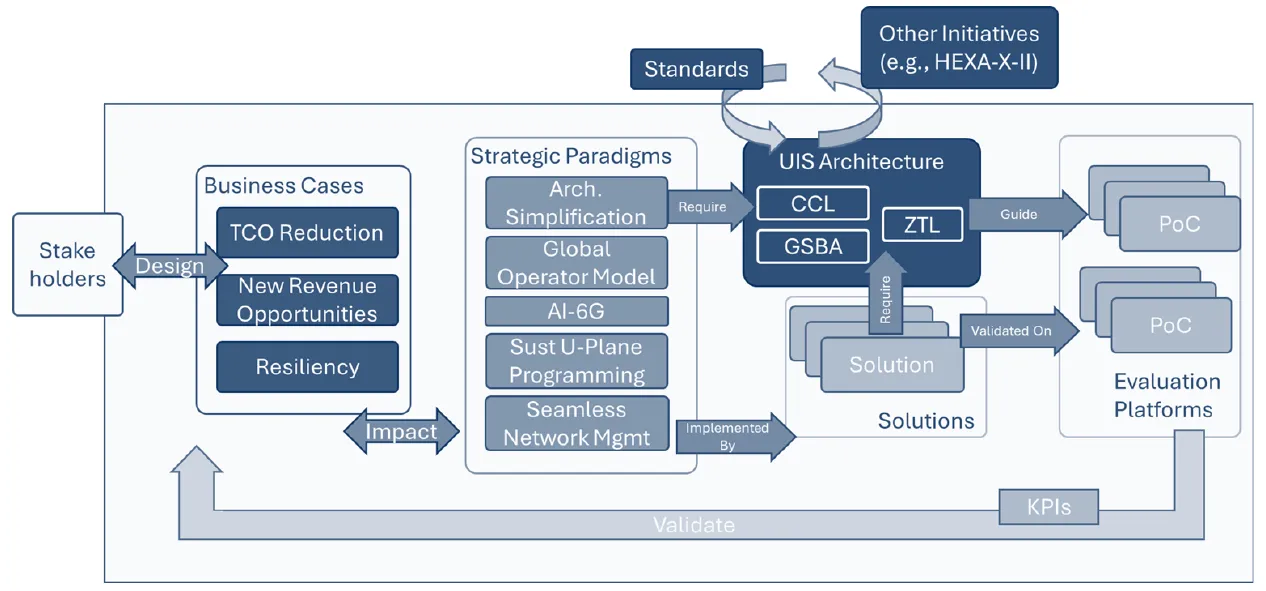
PROSPERO organises its methodology around three business cases: TCO reduction, new business opportunities, and network resiliency.
These business cases are addressed through five strategic paradigms that build on the project architectural components and are validated through measurable technical and business KPIs.
The scheme combines business goals, architectural models, and validation mechanisms. The following terms are the main building blocks needed to read it.
Business case
Lowering CAPEX and OPEX through architectural simplification, energy-aware management, resource pooling, and efficient use of general-purpose compute infrastructure.
Business case
Opening the 6G architecture to new services, marketplaces, AI workloads, and secure exposure of network capabilities for operators, enterprises, and third-party innovators.
Business case
Building resilience into the architecture through zero-trust interactions, secure operations, emergency resource sharing, and continuity of critical communications.
A service-based architecture that extends SBA principles across network and computing domains. PROSPERO builds on this concept towards virtualized, programmable service instances and codelets.
A unified abstraction fabric for heterogeneous compute resources, from CPUs and GPUs to accelerators. It supports software RAN, resource pooling, energy efficiency, and distributed AI execution.
A layer for secure and auditable interactions among entities in open distributed networks. PROSPERO extends this concept with hardware-anchored trust, trusted execution, and programmable in-network defence.
A frugal, purpose-driven AI approach for 6G operations. PROSPERO organises it into AI-for-6G for automation, AI-and-6G for shared compute, and AI-on-6G for services built on network data.
Measures used to check whether each technical solution meets its expected performance contribution and supports the target business cases.
A dedicated validation activity used to test the practical viability of PROSPERO technical solutions against the project KPIs.
Technical solutions are evaluated through PoCs and checked against the initial business cases. The results either validate the solutions or feed updates back into their design.
Architectural simplification, global operation, AI-6G integration, sustainable network programming, and seamless network management.
AI/ML algorithms, analytical models, optimisation frameworks, and control systems designed around the project architectural components.
Dedicated proof-of-concept validations measure technical performance and practical viability against project KPIs.
Results are checked against TCO reduction, new revenue opportunities, and resiliency to refine or validate the solutions.
The work plan is organised in five work packages. WP2 defines requirements and architecture; WP3 develops technical designs and validation concepts; WP4 implements and evaluates the solutions; WP5 feeds stakeholder, business, standardisation, and dissemination input back into the technical work.
The interaction among work packages follows an iterative waterfall approach. Initial, intermediate, and final iterations support feedback across architecture, design, and validation through the 36-month project.
Lead: TID · Timeline: M1-M36
Lead: UC3M · Timeline: M1-M30
Lead: NOK · Timeline: M3-M33
Lead: IMDEA · Timeline: M6-M36
Lead: RW · Timeline: M1-M36
WP2 starts from stakeholder needs, business cases, and standardisation input to define requirements for the project architecture, AI-6G, and cross-domain operation. These requirements guide the design of modules, interfaces, and operational procedures.
WP3 transforms the architecture into detailed technical designs for TCO reduction, new revenue opportunities, and resiliency. It also defines validation concepts for the solutions later implemented in WP4.
WP4 implements prototypes and emulation-based validations for the designed innovations, covering energy-aware AI, vDU scaling, AI-driven services, and secure-by-default resiliency mechanisms.
WP5 connects results to external stakeholders through communication, dissemination, exploitation, techno-economic analysis, standardisation contributions, open-source engagement, and technology transfer.